NMD disease evidence atlas · multidisease-evidence-v0.2.0
Four diseases, one evidence contract, no pooled biological score.
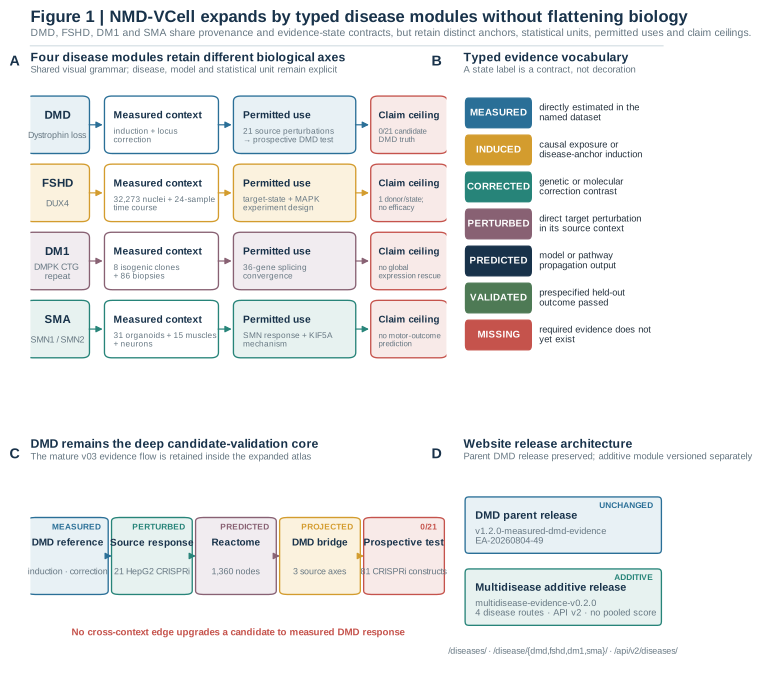
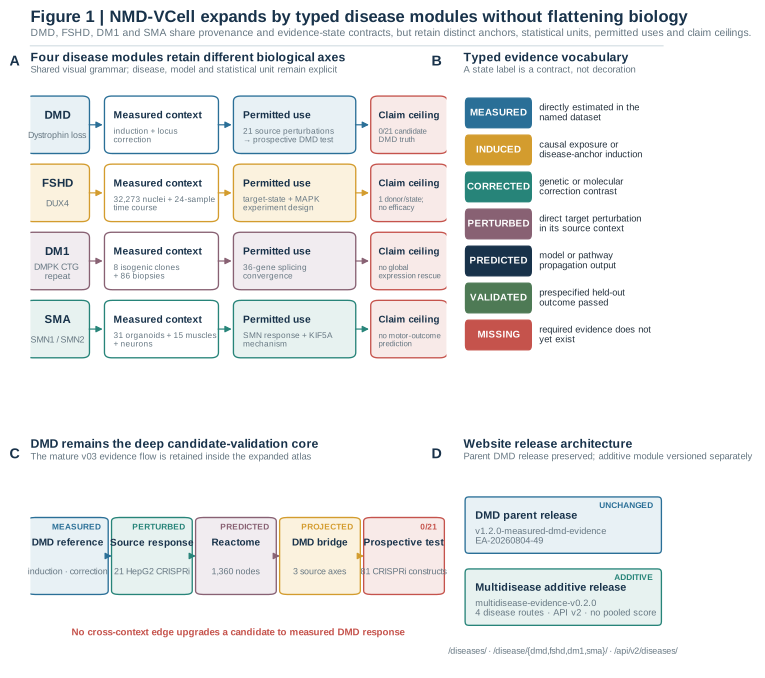
DMD, FSHD, DM1 and SMA now share the same route and API shape while retaining different disease anchors, models, unit structures and claim ceilings.
Module meaning contract
Diseases · what this module can change
Next handoffChoose a disease route; use the DMD interactive workflow where supported or follow the disease-specific next experiment. Continue →
DMD
Dystrophin lossMeasured DMD induction and locus correction are connected to a governed 21-candidate prospective test queue.
Deep measured context · candidate outcome pendingOpen unified disease route →Patient state · induced timing · directional scRNAFSHD
DUX4Sparse patient-state activation is linked to a causal DUX4 time course and an analysis-plan-frozen membrane-injury extension.
Measured + induced · line-blocked directional extensionOpen unified disease route →Patient evidence · isogenic correctionDM1
DMPK CTG repeatRepeat excision and patient splicing are linked without collapsing PSI into global expression rescue.
Measured splicing · isogenic correctionOpen unified disease route →Neural response · residual muscle · directional scRNASMA
SMN1 / SMN2Human neural response evidence is separated from residual treated-muscle signals and a registered cell-resolution extension.
Measured neural response · line-aggregated extensionOpen unified disease route →Evidence to action
Each disease hands off to a different decisive object.
| Disease | What is established now | Next decisive object | Correct handoff |
|---|---|---|---|
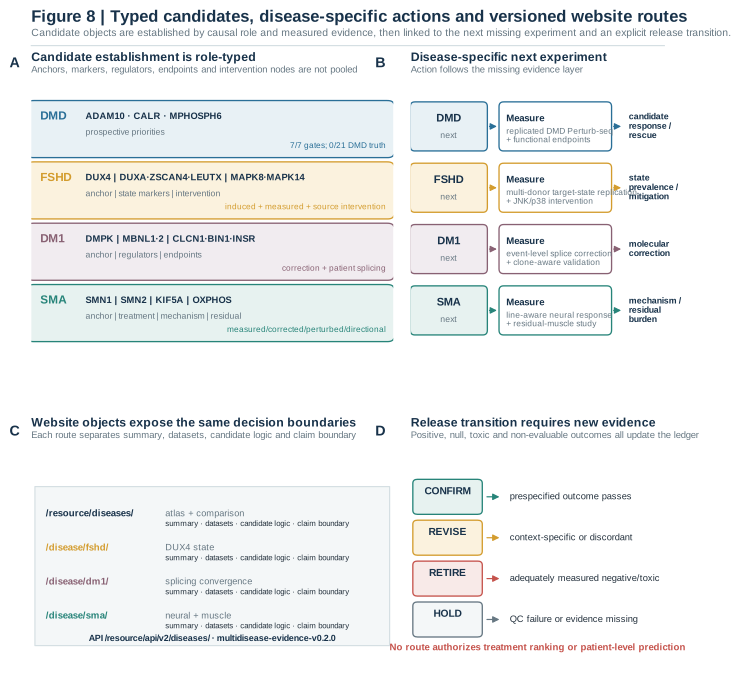
| DMD | Measured induction/correction plus patient-muscle pathways; 21 candidates remain prospective. | Matched DMD/control myogenic perturbation with a frozen endpoint. | Open DMD question gate → |
| FSHD | Patient state, causal DUX4 timing and line-aware membrane-injury localization. | Line-balanced perturbation of membrane-repair/ferroptotic hypotheses with donor-level inference. | Open FSHD evidence → |
| DM1 | Repeat correction converges with patient evidence on 36 splicing genes, not global expression rescue. | Orthogonal splicing and function validation with clone/biopsy units preserved. | Open DM1 evidence → |
| SMA | Neural intervention response and residual treated-muscle signals remain context-separated. | Line-balanced, state-specific functional response test without inferring motor outcome. | Open SMA evidence → |
DMD has interactive Questions, Gene compare and draft Study Cards. FSHD, DM1 and SMA currently hand off to disease-specific evidence and next-experiment recommendations; they do not inherit the DMD predictor or prospective registry.
Selected cross-version architecture
The richer curated Figure 1 replaces the reduced three-module diagram.
Candidate logic
Anchors, markers, endpoints and candidates are role-typed.
- Four unified disease routes
- Strict state plus qualifiers
- Stable candidate and dataset IDs
- Source-level null and missing evidence
- Cross-disease winner score
- Calibrated patient simulation
- Treatment ranking
- Clinical recommendation