NMD-VCell Neuromuscular Virtual Cell Research Platform Module: Models · Evidence → perturbation → experiment → outcome NMD = neuromuscular disorders

Release 2026.08DMD context observedDMD candidate-conditioned prediction not yet eligible

View scientific status
Evidence freeze: 3 August 2026 Resource: v1.2.0-measured-dmd-evidence Schema: 1.1 Open release status →

Model checkBenchmark center

How good is the current model?Four benchmark questions, four independent routes.

Four cards separate what the model can do from what has not yet been tested.Results inside the original dataset, transfer to external data and future out-of-distribution tests are reported separately so their evidence boundaries remain clear.

Product contract · BENCHMARK-CARD-1.0

Benchmark Card: On which sealed truth and permanent baselines did a model advance or stop?

Task identityFrozen truthSplit + leakage groupsSimple baselinesMetric families + seedsAdvance gate + history
Average prediction errorSlightly better than a simple baseline
Direction of changeNot reliable
External datasetDid not transfer
DMD predictionNot tested

What this means: the model is useful as a cautious same-dataset baseline, not as a validated predictor of DMD muscle response.

Generalization at a glanceExecution stops before unseen family, donor, state and DMD disease-line testsThese lanes are separate tasks, not a cumulative model score.

Benchmark Arena

Every model family faces the same frozen task contract.

No single aggregate score

A model only enters a cell when a reproducible run exists for that exact task. Empty cells remain visible; they are not converted into simulated performance.

TaskZero baselineTrain meanRidgeAdvanced adapterCurrent verdict
G0 · same-context holdoutExecutedExecutedExecuted · limitedNot runSmall RMSE gain; strict gate 0/16
G1 · unseen perturbationReferenceReferencePartial · negativeNot runNo directional-transfer support
G2–G5 · family, donor, state, laboratoryRegisteredRegisteredRegisteredRegisteredNot executed
G6 · independent DMD lineLockedLockedLockedLockedNo disease-context outcomes
G7 · KO, OE and combinationsAdditive nullLockedLockedLockedNo learned interaction result

Reading rule: “not run”, “registered” and “locked” describe missing evaluation—not model failure. Advanced models must beat the permanent simple baselines on prospective holdouts before they can support a stronger claim.

NMD Benchmark Suite

Eight tasks; each has its own truth, baseline, metric and blocker.

G0Executed · limited

Same-context target holdout

unseen target inside the processed HepG2 assay

Output
Held-out 2,000-feature mean response vector
Permanent baselines
zero change · train mean · ridge
Primary metrics
RMSE · raw cosine · residual cosine · strict 16-outcome gate
Current result
Small average-error gain; strict gate 0/16 and direction unreliable
No external cell-level or disease-context truthOpen task route →
G1Partial · unsupported

External unseen perturbation

new perturbation in an external aggregate object

Output
Directional-transfer assessment
Permanent baselines
zero change · train mean · ridge
Primary metrics
formula-aligned aggregate directional diagnostics
Current result
No directional-transfer support
No harmonized cell-population outcome or matched feature spaceOpen task route →
G2Registered · not executed

Unseen gene family or pathway

held-out related targets with leakage-safe exposure audit

Output
Held-out family response distribution
Permanent baselines
zero change · train mean · ridge · nearest neighbour
Primary metrics
DES · PDS · MAE · calibration · abstention
Current result
No result
Current candidate set is too small for a powered family holdoutOpen task route →
G3Locked · no donor-indexed perturbation outcome

Unseen donor

entire donor withheld

Output
Donor-conditioned response and responder distribution
Permanent baselines
population mean · donor-agnostic ridge · nearest donor
Primary metrics
calibration · donor replication · distribution distance · abstention
Current result
No result
No qualifying donor-resolved DMD perturbation matrixOpen task route →
G4Locked · no perturbed state transition

Unseen cell state

train in one myogenic state and test another

Output
State-conditioned population transition
Permanent baselines
unperturbed trajectory · state mean · additive shift
Primary metrics
state occupancy · DES · PDS · MAE · transport distance
Current result
No result
Current myogenic trajectory is real but unperturbedOpen task route →
G5Locked · no prospective batch

Future batch or external laboratory

prospective time and site shift

Output
Prospective response, uncertainty and abstention
Permanent baselines
historical mean · ridge · expert selection
Primary metrics
calibration · AUPRC · hit enrichment · abstention quality
Current result
No result
No registered prediction or future outcomeOpen task route →
G6Locked · zero DMD outcomes

Independent DMD disease line

new disease line or genotype

Output
Molecular, functional, toxicity and replication outcomes
Permanent baselines
zero · train mean · ridge · expert choice · random selection
Primary metrics
functional hit rate · AUPRC · calibration · toxicity miss rate · replication
Current result
No result
0 independent DMD candidate-perturbation outcomesOpen task route →
G7Locked · calibration references only

New modality and combination

KO, CRISPRa, drug or double perturbation

Output
Main effects, interaction, synergy class and uncertainty
Permanent baselines
additive null · pathway mean · nearest neighbour
Primary metrics
interaction error · synergy classification · calibration · toxicity
Current result
Only an additive no-interaction preview is available
No observed candidate doubles or matched DMD drug screensOpen task route →

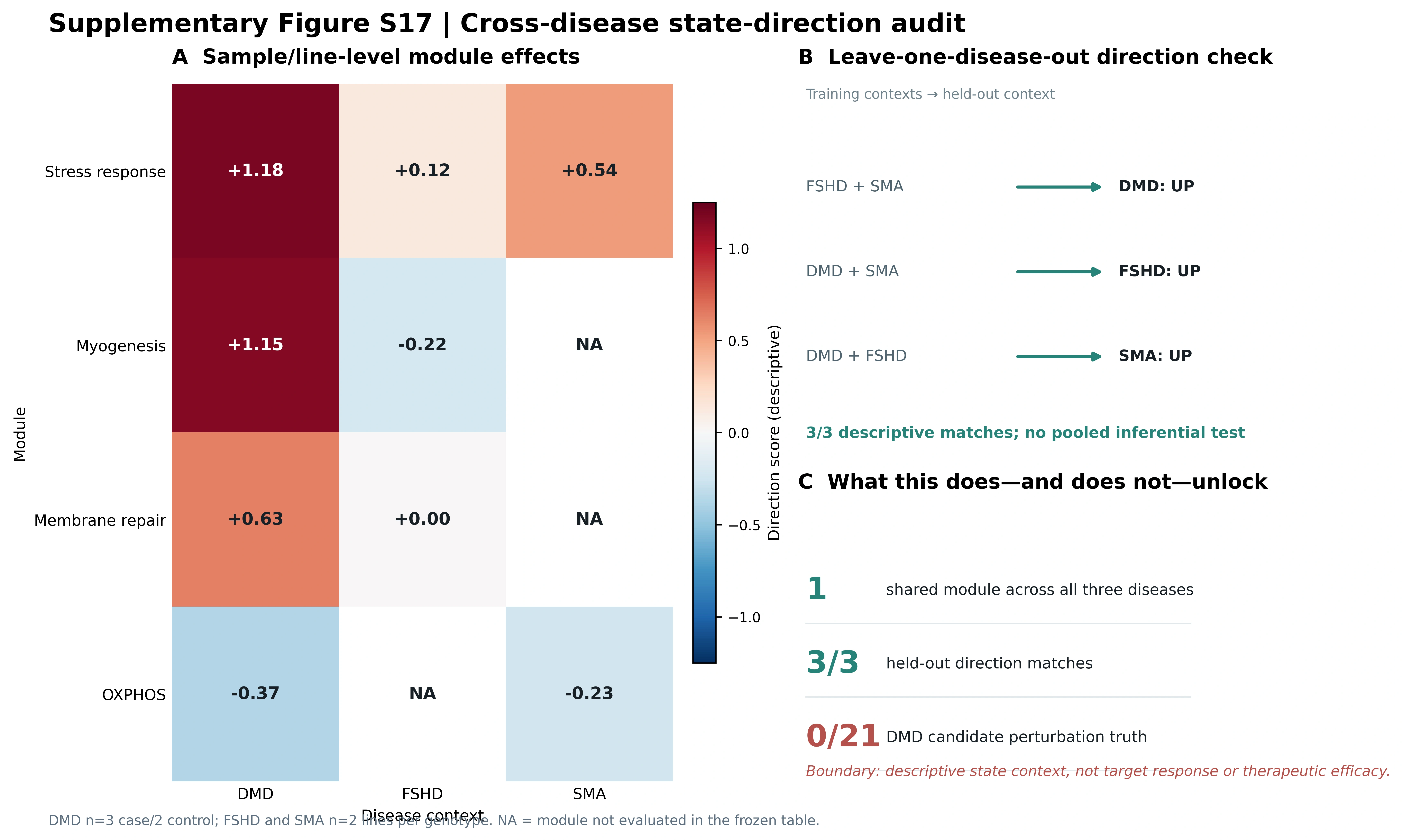
New · v1.3 cross-disease state audit

DMD, FSHD and SMA share one descriptive stress-direction signal.

Sample-aware · not candidate efficacy

The frozen module tables show Stress_response above the within-dataset reference in all three disease contexts. Leave-one-disease-out direction checks match in 3/3 held-out contexts. This is a state-context audit, not a pooled disease score, target-response prediction or therapeutic ranking.

ModuleDMDFSHDSMAInterpretation
Stress response+1.18 · UP+0.12 · UP+0.54 · UPCommon module; 3/3 descriptive held-out direction matches
Myogenesis+1.15 · UP−0.22 · DOWNNAContext-specific; not pooled
Membrane repair+0.63 · UP+0.00 · UPNAContext-specific; not pooled
OXPHOS−0.37 · DOWNNA−0.23 · DOWNContext-specific; not pooled
Evidence boundary: DMD sample-level units are 3 case versus 2 control; FSHD and SMA use 2 lines per genotype. The audit adds no candidate-level DMD perturbation outcome: 0/21. It does not unlock a DMD virtual-cell prediction.

Global benchmark lens

Expression error alone is not enough—and raw PDS is not enough.

The Arc Virtual Cell Challenge separates differential-expression recovery, perturbation discrimination and global expression error. NMD-VCell expands this into a seven-family metric firewall and requires PDS scale diagnostics before interpretation.

DESDifferential-expression recoveryDoes the prediction recover perturbation-responsive genes?
PDS+Identity with scale safeguardsRaw, norm-matched and amplitude-sensitivity variants stay together.
MAEGlobal expression errorIs overall expression close—without hiding a trivial mean predictor?
DISTPopulation geometryDo predicted cells occupy the observed distribution?
CALCalibration and abstentionDoes uncertainty mean what the model says it means?
DMDFunction, replication and safetyDoes molecular fidelity translate into a reproducible disease-relevant result?
Open the complete metric firewall · Arc metric design · primary source · PDS sensitivity preprint

01 · Same-context

Core HepG2 benchmark

Repeated-fold error, raw direction, residual structure and the 16 frozen strict outcomes.

Open core benchmark →
02 · External aggregate

External-transfer diagnostic

Formula-aligned aggregate metrics on 55 Frangieh targets; no directional-transfer support.

Open external transfer →
03 · OOD matrix

G0–G7 generalization ladder

Unseen perturbation, family, donor, state, laboratory, disease and modality are reported independently.

Open generalization ladder →
04 · Future-task audit

VCC 2026 readiness

Infrastructure gap matrix, official-source watch and task-binding locks before launch.

Open VCC readiness →
Boundary. Results on one route do not upgrade another. The external 55-target object is not a VCC score, and VCC readiness is not task compatibility.