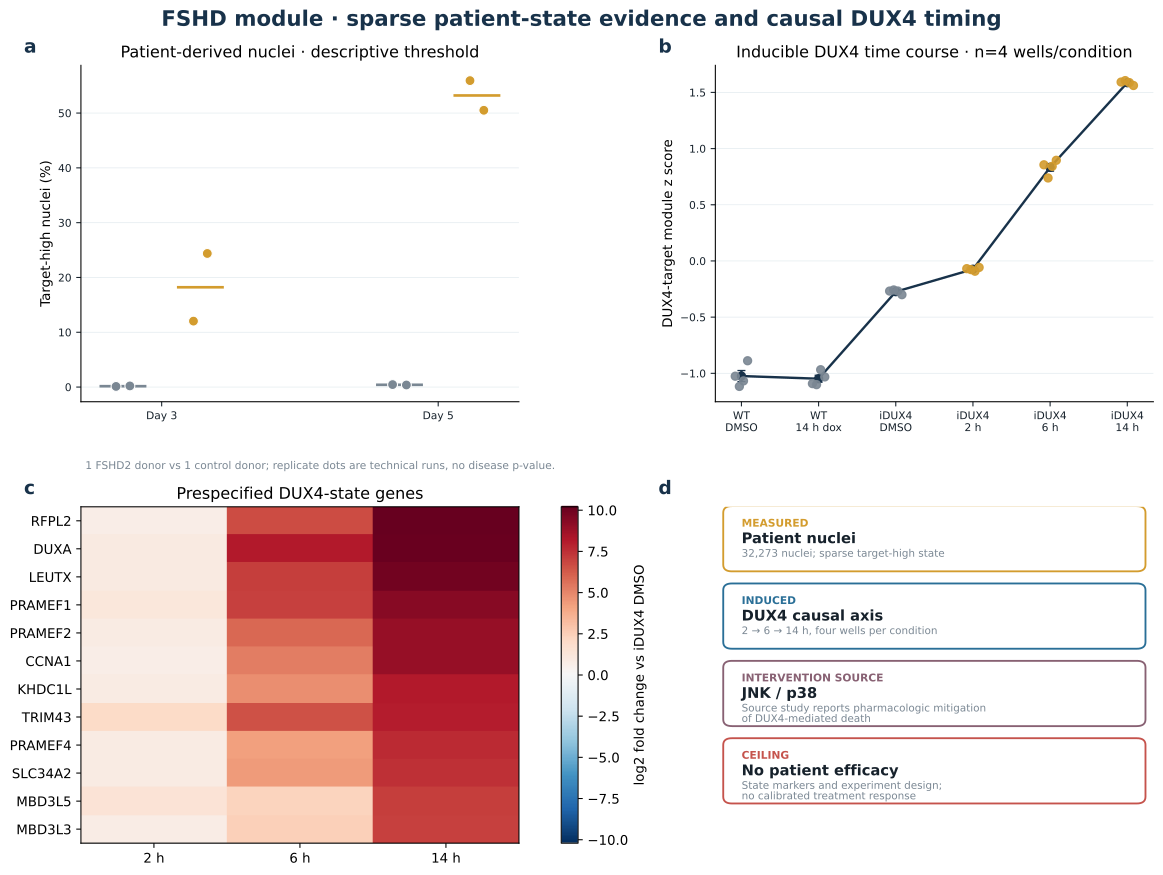
Positive, null and missing evidence remain separate.
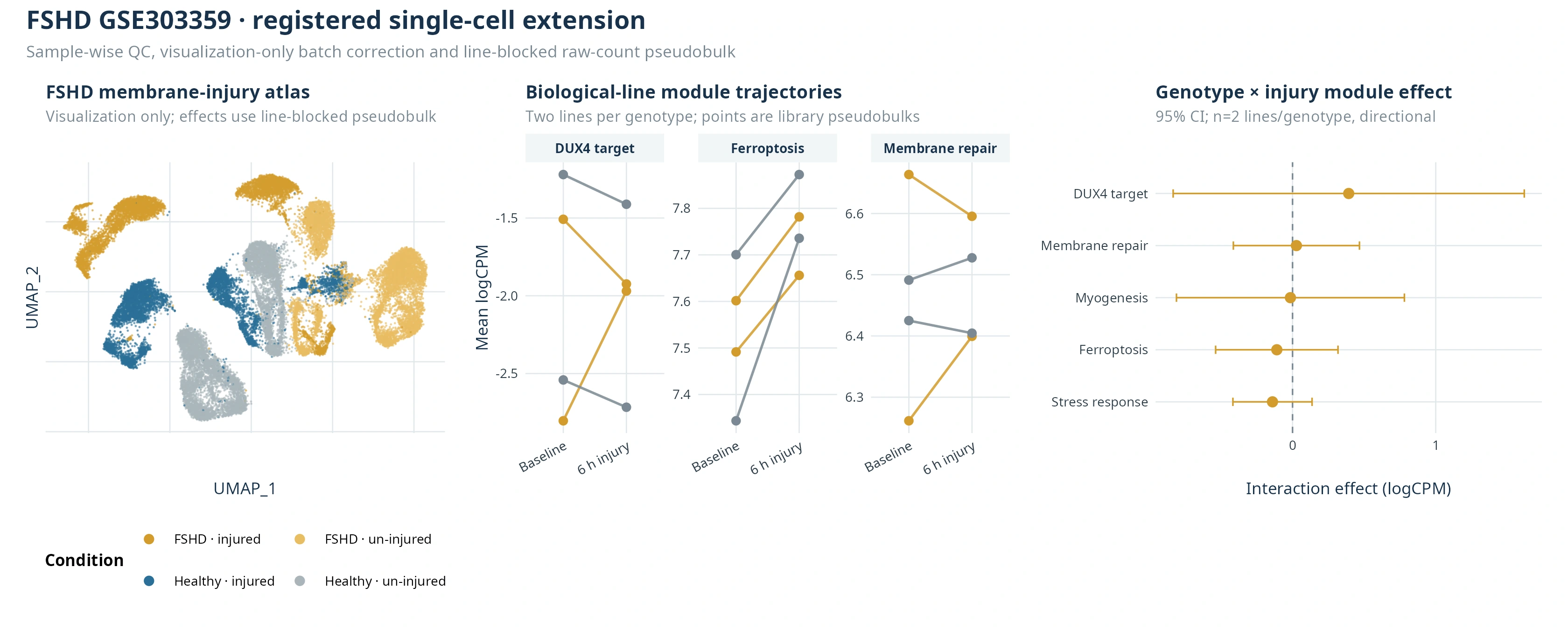
GSE303359 adds 40,289 QC-retained cells from four biological lines and uses line-blocked repeated-injury pseudobulk. The lowest-FDR prespecified interaction module was DUX4_target (FDR 0.883). With two lines per genotype, this is directional state-localization evidence and promotes no candidate to VALIDATED.
Selected evidence figure
Measured context and claim ceiling stay visible together.
NMD-VCell reanalysis: line-blocked voom-limma pseudobulk with repeated baseline/injury measures. This extension refines state localization and the next experiment; it is not a public timestamped registration and does not validate a therapeutic target. The QC-table serialization repair is separately audited and did not modify statistical fields. The directly hosted disease vector is a byte-preserving gzip of the source SVG; raw vectors and standalone per-disease/combined PDFs remain checksum-addressed in the source release, while the synchronized v08.7 packet carries the publication figures.
8 single-cell libraries; large raw matrix registered, not reanalyzed in v01
Unit: cell line/donor after technical-library aggregation; two FSHD and two healthy lines Role: Current membrane-repair / ferroptotic-stress extension
Candidate establishment
Role-typed objects link directly to the next missing experiment.
Object
Role
State + qualifiers
Permitted interpretation / next experiment
DUX4 NMDVCELL:FSHD:CANDIDATE:DUX4Identifiers & provenancemodule/endpoint Datasets: GSE143452, GSE205421, GSE303359 Unit structure: donor; one FSHD2 and one control donor, descriptive only; independent culture well; four wells per condition; cell line/donor after technical-library aggregation; two FSHD and two healthy lines
etiologic_anchor
INDUCED
SINGLE_CELL_STATE_LOCALIZATIONNO_TARGET_PROMOTION
Disease-initiating transcription factor; not a ranked outputNext missing experimentRetain as the disease reference axis; do not reinterpret it as a ranked therapeutic output.
DUXA NMDVCELL:FSHD:CANDIDATE:DUXAIdentifiers & provenanceHGNC:32179 · ENSG00000258873 Datasets: GSE143452, GSE205421, GSE303359 Unit structure: donor; one FSHD2 and one control donor, descriptive only; independent culture well; four wells per condition; cell line/donor after technical-library aggregation; two FSHD and two healthy lines
Downstream state marker; not therapeutic validationNext missing experimentConfirm donor-level prevalence and intervention responsiveness in independent disease-relevant biological units.
ZSCAN4 NMDVCELL:FSHD:CANDIDATE:ZSCAN4Identifiers & provenancemodule/endpoint Datasets: GSE143452, GSE205421, GSE303359 Unit structure: donor; one FSHD2 and one control donor, descriptive only; independent culture well; four wells per condition; cell line/donor after technical-library aggregation; two FSHD and two healthy lines
Downstream state marker; not therapeutic validationNext missing experimentConfirm donor-level prevalence and intervention responsiveness in independent disease-relevant biological units.
LEUTX NMDVCELL:FSHD:CANDIDATE:LEUTXIdentifiers & provenancemodule/endpoint Datasets: GSE143452, GSE205421, GSE303359 Unit structure: donor; one FSHD2 and one control donor, descriptive only; independent culture well; four wells per condition; cell line/donor after technical-library aggregation; two FSHD and two healthy lines
Downstream state marker; not therapeutic validationNext missing experimentConfirm donor-level prevalence and intervention responsiveness in independent disease-relevant biological units.
MAPK8 NMDVCELL:FSHD:CANDIDATE:MAPK8Identifiers & provenanceHGNC:6881 · ENSG00000107643 Datasets: GSE205421, GSE303359 Unit structure: independent culture well; four wells per condition; cell line/donor after technical-library aggregation; two FSHD and two healthy lines
Experiment-design node; no patient efficacy claimNext missing experimentProspectively perturb with replicate-aware controls and a prespecified disease-relevant endpoint.
MAPK14 NMDVCELL:FSHD:CANDIDATE:MAPK14Identifiers & provenanceHGNC:6876 · ENSG00000112062 Datasets: GSE205421, GSE303359 Unit structure: independent culture well; four wells per condition; cell line/donor after technical-library aggregation; two FSHD and two healthy lines
Experiment-design node; no patient efficacy claimNext missing experimentProspectively perturb with replicate-aware controls and a prespecified disease-relevant endpoint.
Supports
DUX4-target state stratification
induction kinetics
stress-intervention experiment design
Does not support
patient-calibrated efficacy
therapeutic ranking
donor-general disease prevalence from one donor per state
Machine-readable module
Summary, datasets, candidate logic and claim boundary are separate objects.