Disease evidence coverage
Compare evidence depth without naming a disease winner.
States are categorical contracts. MISSING is not zero, and a cell never substitutes for the underlying statistical unit or effect estimate.
| Evidence dimension | DMD | FSHD | DM1 | SMA |
|---|---|---|---|---|
| Etiologic anchor | MEASURED | INDUCED | CORRECTED | MEASURED |
| Patient/disease state | MEASURED | MEASURED | MEASURED | MEASURED |
| Causal induction/correction | CORRECTED | INDUCED | CORRECTED | CORRECTED |
| Intervention/perturbation | PERTURBED | MEASURED | MISSING | PERTURBED |
| Independent replication | MEASURED | MISSING | MEASURED | MEASURED |
| Prospective candidate validation | MISSING | MISSING | MISSING | MISSING |
Cells are typed evidence states, not numerical scores; MISSING is not zero and no row is ranked.
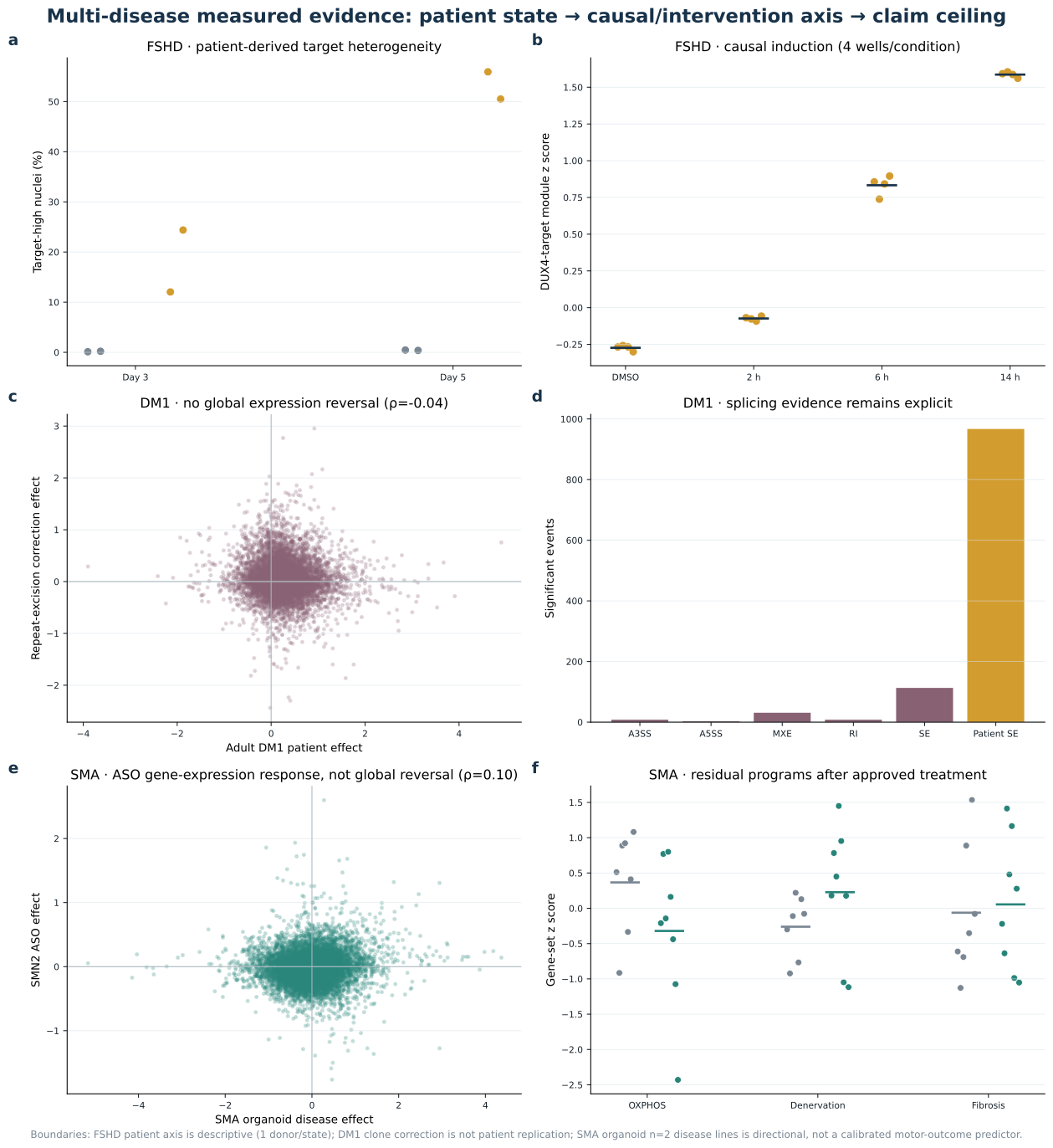
Measured reanalysis
Patient state, causal/intervention axis and null results.
Analysis-plan-frozen single-cell layer
FSHD injury and SMA organoid states are compared at the correct biological-unit level.
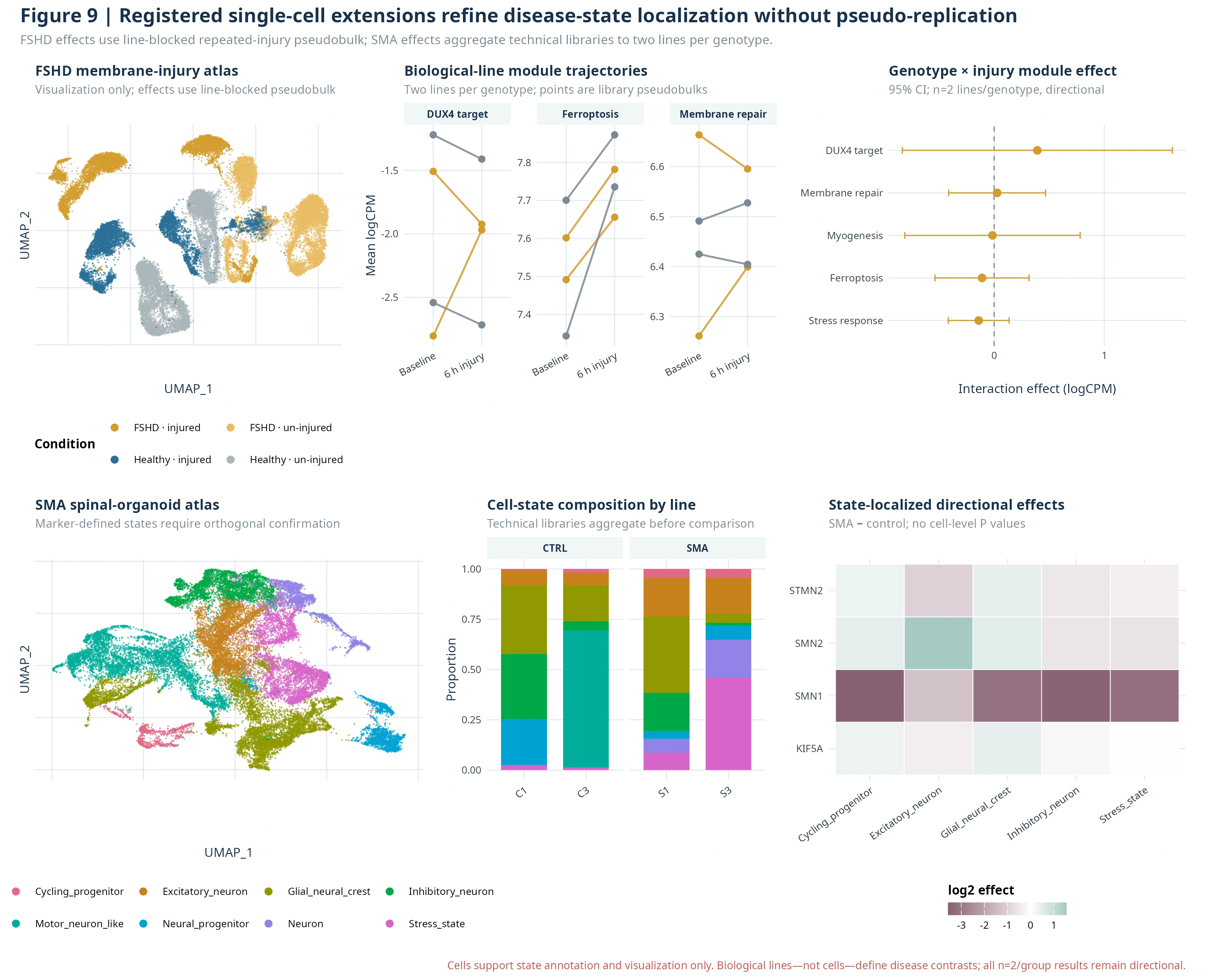
The combined view is a state-localization layer, not a pooled cross-disease score. No therapeutic candidate is promoted to validated status. The two disease vectors are hosted separately; the combined standalone SVG/PDF remains checksum-addressed in the source release.
FSHD vector (SVG.gz) Source release only · open manifestSMA vector (SVG.gz) Source release only · open manifest