Positive, null and missing evidence remain separate.
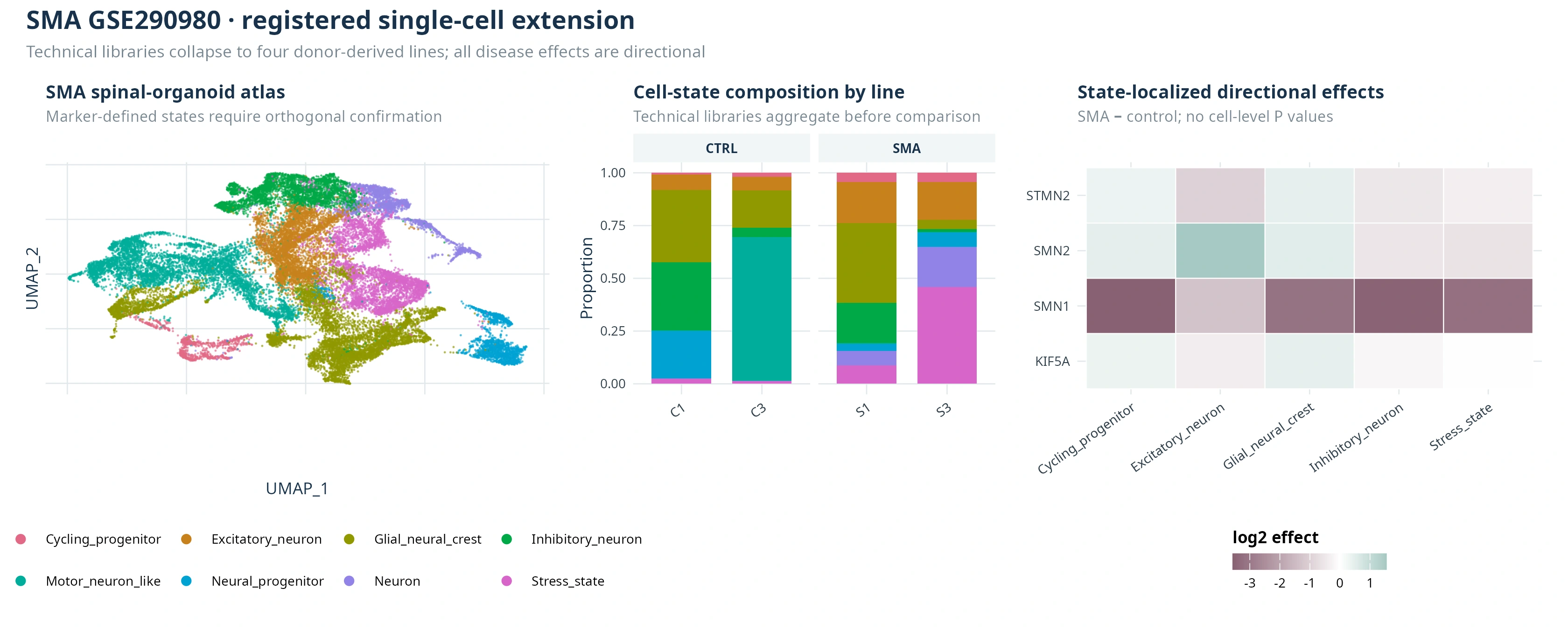
GSE290980 adds 37,157 QC-retained cells after collapsing eight technical libraries to four biological lines. The largest marker-defined composition shift involved Motor_neuron_like. Effects remain directional (two lines per genotype), marker-defined identities require confirmation and no candidate is promoted to VALIDATED.
Selected evidence figure
Measured context and claim ceiling stay visible together.
NMD-VCell reanalysis: technical-library aggregation followed by line-level directional effects without calibrated p-values. This extension refines state localization and the next experiment; it is not a public timestamped registration and does not validate a therapeutic target. The QC-table serialization repair is separately audited and did not modify statistical fields. The directly hosted disease vector is a byte-preserving gzip of the source SVG; raw vectors and standalone per-disease/combined PDFs remain checksum-addressed in the source release, while the synchronized v08.7 packet carries the publication figures.
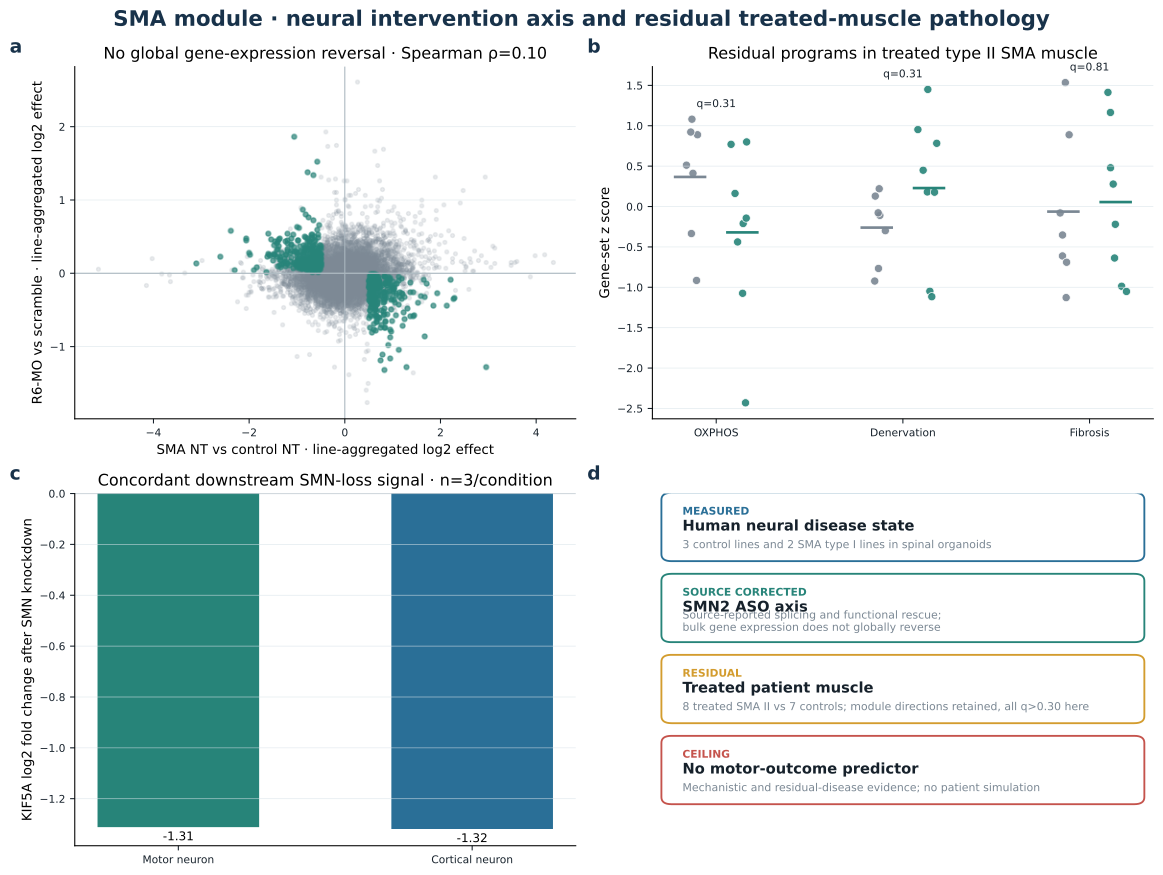
Human motor and cortical neurons after SMN knockdown
3 replicates per condition in each neural context
Unit: independent culture replicate within each neuronal context Role: Orthogonal KIF5A downstream mechanism evidence
Candidate establishment
Role-typed objects link directly to the next missing experiment.
Object
Role
State + qualifiers
Permitted interpretation / next experiment
SMN1 NMDVCELL:SMA:CANDIDATE:SMN1Identifiers & provenanceHGNC:11117 · ENSG00000172062 Datasets: GSE290979, GSE252128, GSE302774, GSE290980 Unit structure: donor-derived organoid line; technical samples are not biological replicates; independent skeletal-muscle biopsy; independent culture replicate within each neuronal context; donor-derived organoid line after technical-replicate aggregation; two lines per genotype
etiologic_anchor
MEASURED
SINGLE_CELL_STATE_LOCALIZATIONNO_TARGET_PROMOTION
Disease anchorNext missing experimentRetain as the disease reference axis; do not reinterpret it as a ranked therapeutic output.
SMN2 NMDVCELL:SMA:CANDIDATE:SMN2Identifiers & provenanceHGNC:11118 · ENSG00000205571 Datasets: GSE290979, GSE290980 Unit structure: donor-derived organoid line; technical samples are not biological replicates; donor-derived organoid line after technical-replicate aggregation; two lines per genotype
Positive-control treatment axis; bulk expression did not globally reverseNext missing experimentUse as a positive-control axis while measuring residual cell-state and functional endpoints.
KIF5A NMDVCELL:SMA:CANDIDATE:KIF5AIdentifiers & provenanceHGNC:6323 · ENSG00000155980 Datasets: GSE302774, GSE290980 Unit structure: independent culture replicate within each neuronal context; donor-derived organoid line after technical-replicate aggregation; two lines per genotype
downstream_candidate
PERTURBED
SINGLE_CELL_STATE_LOCALIZATIONNO_TARGET_PROMOTION
Mechanistic candidate; source-reported functional rescue, no patient efficacyNext missing experimentPerturb in line-aware motor-neuron models and test rescue plus toxicity endpoints.
OXPHOS_MODULE NMDVCELL:SMA:CANDIDATE:OXPHOS_MODULEIdentifiers & provenancemodule/endpoint Datasets: GSE252128, GSE290980 Unit structure: independent skeletal-muscle biopsy; donor-derived organoid line after technical-replicate aggregation; two lines per genotype
Combination-therapy hypothesis space; no single target rank or significant module claimNext missing experimentReplicate the program in an independent treated cohort before resolving individual targets.
Supports
human neural disease/intervention response
source-reported SMN2 splicing and functional rescue
KIF5A downstream mechanism
residual-muscle hypotheses
Does not support
global gene-expression reversal
significant OXPHOS/denervation/fibrosis module claim in this reanalysis
patient motor-outcome prediction
combination-therapy ranking
Machine-readable module
Summary, datasets, candidate logic and claim boundary are separate objects.