NMD-VCell Research Workbench Module: Perturbation Lab · evidence-to-experiment workflow NMD = neuromuscular disorders
Research evidence only 21 observed HepG2 perturbations 0 independent DMD replications Boundary & release
Observed HepG2 perturbations with limited external myogenic context No validated DMD perturbation prediction v1.0.0-database-resource Frozen 25 Jul 2026 Schema 1.1 Model ridge-safe-v2.3 Benchmark repeated-fold-v2.2 Build EA-20260729-20 DOI pending Open evidence boundary →

Perturbation Lab

Inspect observed perturbation responses and bounded additive hypotheses.

Choose a context, modality and gene first. Counterfactual, interaction and perturbed-fate predictions remain unavailable until matched data exist.

What happened when this gene was perturbed?

WDR4 was perturbed with CRISPRi in HepG2 cells.

Cell contextHepG2—not a DMD muscle model
Observed readoutFrozen gene-expression response
Muscle / DMD validationNot independently replicated
Next useful experimentControlled myogenic perturbation with replication

Boundary: the pair view is an additive “no-interaction” preview. This is not a predicted double perturbation.

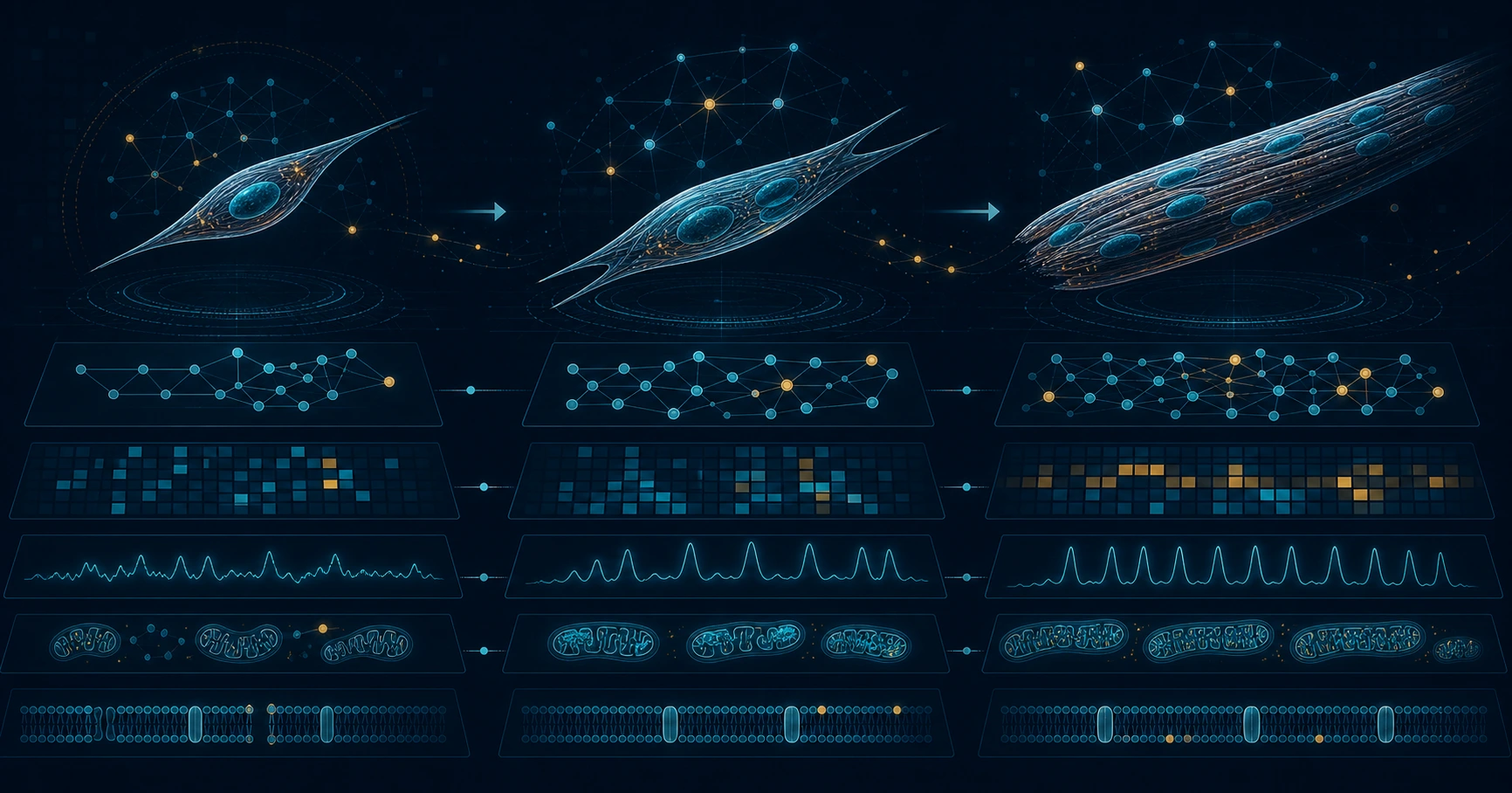
Read the simulation from left to right A perturbation identity is only the first step toward a DMD outcome Colour indicates the strongest evidence currently available at each stage.
DefineGene + CRISPRiHepG2 · endpoint aggregateObserved
0 hTarget perturbation21 singleton aggregatesObserved
6–12 hEarly mechanismResponse-program descriptionPartial
24–48 hCell-state transitionNeeds perturbed time courseLocked
4–7 dDMD functionNeeds myogenic replicationLocked
Pair previewδA + δBInteraction γAB remains unknown until observed doubles exist.

Perturbation evidence and preview ladder

Every view carries its evidence role

No automatic target ranking
SIM-L0Observed single CRISPRiFrozen HepG2 aggregate
SIM-L1Predicted single CRISPRiExperimental; strict direct gate unsupported
SIM-L2Additive “no-interaction” previewδA + δB; interaction omitted · not a predicted double perturbation
SIM-L3Pair interactionNeeds observed doubles
SIM-L4Context and fateKO, OE, muscle transfer and trajectory locked

Capability boundary

Available now versus data required

Available now

Evidence-backed views

  • Observed CRISPRi · 21 frozen HepG2 singleton aggregates
  • Additive hypothesis · δA + δB null preview with no interaction term
  • Reference trajectory · real unperturbed human-myogenic time course
Unavailable · data required

Locked outputs

  • Knockout · matched KO and editing calibration
  • CRISPRa / overexpression · matched muscle or DMD activation response
  • Interaction · observed same-screen doubles
  • Perturbed fate · dynamic perturbation sampling

Locked items expose only their unlock conditions; they do not emit simulated values.

External evidence registry

Four public reference datasets are qualified—each with a different permitted role

The cards separate direct perturbation evidence, muscle phenotype screening, DMD correction, unperturbed myogenic time evolution and cross-cell-line CRISPRa-combination calibration.

No candidate-level DMD replication
Current substrateHepG2 CRISPRi

21 observed single perturbations remain the only direct response substrate in the browser.

Direct candidates
21
Observed doubles
0
Direct · context-limited
GSE293514Human myoblast fusion screen

Muscle-context KO/fusion qualification; absence from the fusion-hit set is endpoint-specific, not proof of no muscle function.

21-gene library coverage
9/21
Fusion hits
0
Bounded context
GSE272233DMD CRISPR-correction reference

Bulk RNA-seq from three exon-duplication backgrounds and matched corrected clones; candidate transcripts are observations, not candidate perturbation effects.

Samples
21
Correction DE calls
5923
Orthogonal reference
GSE52529Human myogenic time course

Primary human skeletal myoblast single cells at 0, 24, 48 and 72 hours, with distributed pseudotime and state assignments.

Cells
271
Candidate coverage
20/21
Reference only · not perturbed
GSE133344CRISPRa + pair calibration

K562 single and combinatorial CRISPRa benchmark. It calibrates method design, not muscle-context candidate overexpression effects.

Reported perturbations
287
Feature coverage
20/21
Method calibration only

SIM-L0 · observed CRISPRi

WDR4 observed CRISPRi

Risk/context review. This is an observed HepG2 CRISPRi record linked to descriptive program inputs; independent muscle/DMD perturbation replication is absent.

Observed
Observed cells108Frozen HepG2 CRISPRi aggregate
Counteralignment0.019Contextual signature relationship; not therapeutic rescue
Skeletal-muscle expression4.16 TPMExpression context, not perturbation validation
Independent DMD replication0Scientific unlock remains unmet

Selected-gene external evidence

Context, correction, time-course and calibration evidence

Not a perturbation replication
GSE293514 · human myoblast KOAssessed

Fusion endpoint context only; not DMD rescue.

GSE272233 · DMD correction0/3 significant contrasts

WDR4 transcript response after DMD editing, not WDR4 perturbation.

GSE52529 · myogenic time courseMeasured reference

Unperturbed 0/24/48/72-hour reference; perturbed fate remains locked.

GSE133344 · CRISPRa calibrationExpression feature present

Feature presence is not target coverage and does not unlock overexpression.

Pathway / program lens

Descriptive overlap with frozen gene programs

No enrichment P value
Myogenic / contractile0

No compact-list overlap

ECM / fibrotic0

No compact-list overlap

Inflammatory / stress3

C3, PYCARD, SERPINA1

Cell cycle / proliferation0

No compact-list overlap

Metabolic / secretory2

APOA1, MLXIPL

Proteostasis / membrane0

No compact-list overlap

Response details

Compact response-gene lists

WDR4 compact response list
TSPAN8KRT18MATN3SORL1APOA1MLXIPLHMGB2SERPINA1PYCARDTNFRSF12ANFKBIAC3
Server-rendered frozen inputs; descriptive only.
Current boundary

Observed same-HepG2 CRISPRi evidence only; independent DMD validation is absent.

Open WDR4 evidence record · Open Study Card
Unlock conditions

What the next data release must add

True knockoutMatched KO observations

Editing efficiency, residual expression, controls and context-matched outcomes; CRISPRi cannot be relabelled as KO.

OverexpressionMatched muscle CRISPRa/OE data

GSE133344 now calibrates study and pair design, but activation dose and expression response must be observed in muscle/DMD context; the negative of a knockdown response is not accepted.

Pair interactionObserved double perturbations

Same-screen singletons and doubles with pair-disjoint validation before estimating γAB, synergy or synthetic rescue.

Perturbed trajectoryPair perturbation with dynamic sampling

GSE52529 supplies the unperturbed 0/24/48/72-hour reference. Candidate-conditioned velocity or fate still requires matched perturbation cells sampled across the lineage.

Boundary. The program lens is a descriptive overlap display, not formal pathway enrichment. The pair view is an additive hypothesis, not an observed double perturbation. No output is a treatment, safety, causal-mechanism or clinical recommendation.