GSE293514 · human myoblast KOAssessed
Fusion endpoint context only; not DMD rescue.
Perturbation Lab
Choose a gene and view the observed response, a simple two-gene preview or an external reference.Choose a context, modality and gene first. Counterfactual, interaction and perturbed-fate predictions remain unavailable until matched data exist.
What happened when this gene was perturbed?
Boundary: the pair view is an additive “no-interaction” preview. This is not a predicted double perturbation.
SIM-L2 · additive null
ZNF133 and MON1A are displayed as two observed singleton aggregates under the explicit null δA + δB. No interaction, synergy, synthetic rescue or calibrated pair prediction is emitted.
What this means: this page shows measured or clearly bounded reference information. It does not simulate an unmeasured DMD outcome.
Selected-gene external evidence
Fusion endpoint context only; not DMD rescue.
ZNF133 transcript response after DMD editing, not ZNF133 perturbation.
Unperturbed 0/24/48/72-hour reference; perturbed fate remains locked.
Feature presence is not target coverage and does not unlock overexpression.
Descriptive overlap
ACTA1
CTHRC1, SPP1
SOD2
MKI67, STMN1
APOA1, GPX3, MLXIPL
GPX3
Response details
Additive singleton null only; interaction and uncertainty are unavailable.
Open ZNF133 evidence record · Open Study Card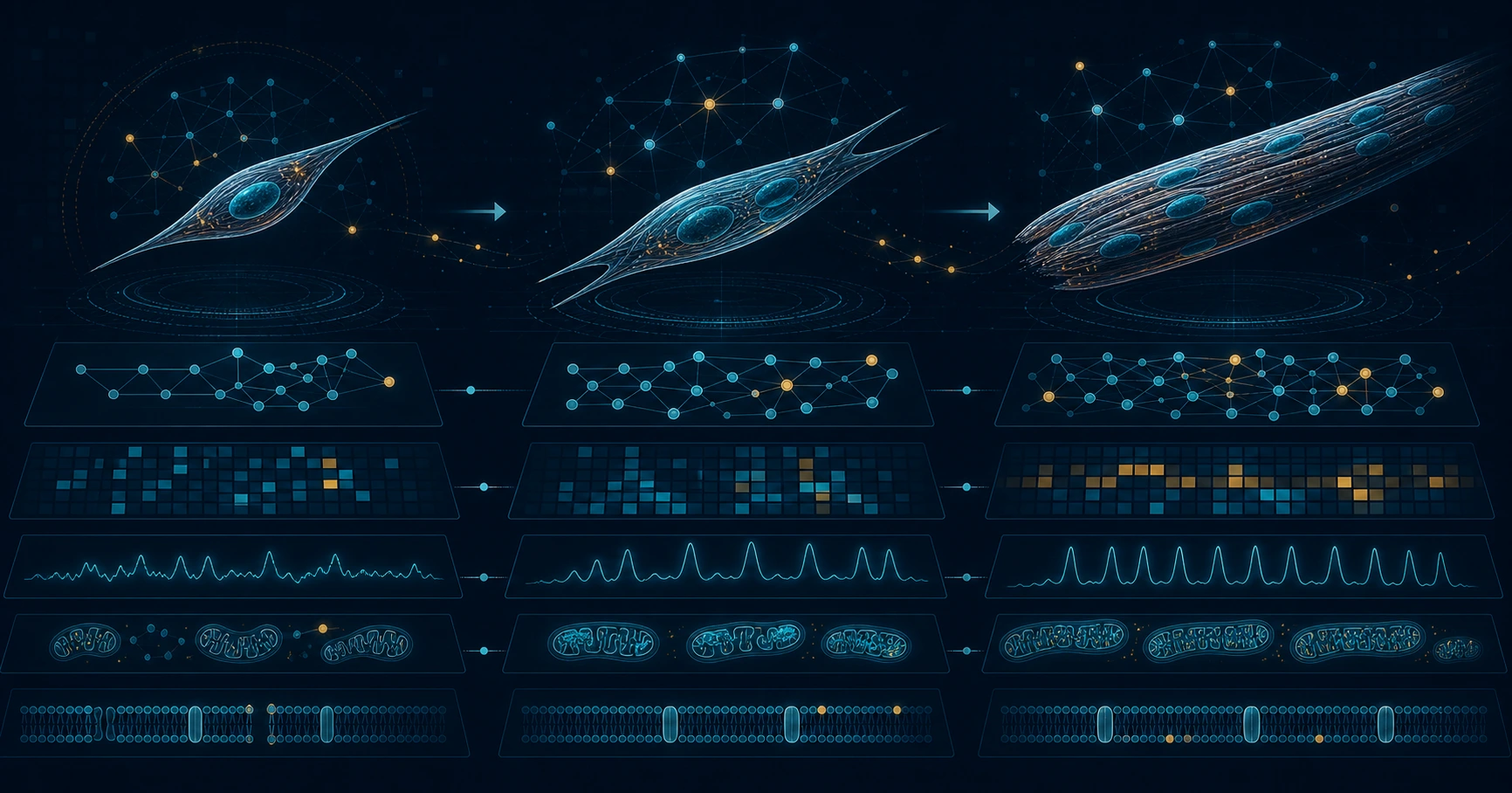
Virtual-cell state transition
A useful virtual cell should connect an intervention to early molecular response, cell-state transition and late muscle function—while retaining uncertainty and replication status.
Perturbation evidence and preview ladder
Capability boundary
Locked items expose only their unlock conditions; they do not emit simulated values.
External evidence registry
The cards separate direct perturbation evidence, muscle phenotype screening, DMD correction, unperturbed myogenic time evolution and cross-cell-line CRISPRa-combination calibration.
21 observed single perturbations remain the only direct response substrate in the browser.
Stage B0 now exposes the observed healthy-human-myoblast network; absence from the fusion-hit set remains endpoint-specific.
Bulk RNA-seq from three exon-duplication backgrounds and matched corrected clones; candidate transcripts are observations, not candidate perturbation effects.
Primary human skeletal myoblast single cells at 0, 24, 48 and 72 hours, with distributed pseudotime and state assignments.
K562 single and combinatorial CRISPRa benchmark. It calibrates method design, not muscle-context candidate overexpression effects.
Unlock conditions
Editing efficiency, residual expression, controls and context-matched outcomes; CRISPRi cannot be relabelled as KO.
GSE133344 now calibrates study and pair design, but activation dose and expression response must be observed in muscle/DMD context; the negative of a knockdown response is not accepted.
Same-screen singletons and doubles with pair-disjoint validation before estimating γAB, synergy or synthetic rescue.
GSE52529 supplies the unperturbed 0/24/48/72-hour reference. Candidate-conditioned velocity or fate still requires matched perturbation cells sampled across the lineage.